


This issue is sponsored by LMNT Electrolytes, my hiking BFF. I’ve always got a pack or two of LMNT’s drink mix in my water reservoir. But my new favorite post-hike treat is pulling a cold can of LMNT Sparkling out of my cooler for the ride home. NOTHING is better than kicking off your dirty hiking shoes, slipping on a comfy pair of sandals, and cracking a crisp, functional sparkling water. LMNT’s new 12-oz cans offer the perfect balance of electrolytes in four delicious, made-for-summer flavors. Get a free LMNT 8-pack sampler of their famous drink mixes with any order, including their cult-favorite Lemonade Salt Sparkling.
I remember my first hike in the White Mountains of NH. I was in high school, and my new boyfriend invited me on a day hike. I had no idea what I was doing. I brought a tiny bottle of water, no snacks, and no layers. I wore sneakers. I don’t remember much of the trail or views because I was just trying to not fall down. I definitely thought, “This is not fun.”
Today, hiking is life. I’ve solo-hiked trails from Norway to Banff, in U.S. National and State Parks, and hundreds of local trails on road trips through the west. Hiking may seem intimidating, but most trails are just walking—sometimes uphill, sometimes with obstacles. If you can walk, you can hike!*
Also, hiking doesn’t have to be uphill or have obstacles. Flat trails count as hiking. Paved trails count as hiking. City trails count as hiking. Very short trails count as hiking. Much like with running, there is no gatekeeping who and who is not a hiker, which is your first “introduction to hiking” lesson.
Are you walking on a trail or path? You’re a hiker! And all you need to get started are these 3 things.
*If you use a wheelchair or other mobility device, you are also hiking! There are plenty of accessible trails, and hiking is NOT just for the able-bodied.
1. Pick a trail
There are a number of ways to find a trail. Google “hiking trails near me” or “easy hikes in Salt Lake City.” Find a hike through word of mouth, like a friend or your city’s Reddit community. Ask a local REI or outdoor store team member for their favorite trails. You can visit your local parks’ websites.
My favorite place to start is the AllTrails app. There is a free version that lets you search for trails, and (with location services turned on) will automatically show you trails in your area. The Pro version lets you download trail maps, which I’d highly recommend for everyone, especially if you’re new. I can’t tell you how many times I’ve lost the trail in snow, near water, or in rocky landscapes. The map is highly accurate even without cell service, and will get you back on track.
AllTrails lets you filter trails by difficulty (easy, moderate, hard, strenuous); by feature (dog-friendly, wheelchair-friendly); distance; or elevation gain. It also features hikes on your explore page, like “best views” or “weekend worthy.”
When you click into a trail, here are three things to review:
1. Distance: Look at the total distance. Is this an “out-and-back” (where the mileage includes the hike out and the hike back); a loop (where you start and end in the same place); or a “point-to-point” (where you end in a different place, requiring a shuttle or some other way to get back to your car). Some trails are less than a mile out-and-back, and that still counts as hiking.
2. Elevation gain: This tells you how much you’ll climb on this trail. You must compare elevation gain to the mileage. Also remember on an out-and-back, all of the elevation gain is almost always in the first half of the trail. (You’ll climb UP to the end of the trail, than back down to your car.) A 2-mile out-and-back trail with 800 feet of gain doesn’t sound steep, but if all of that gain happens on the 1 mile hike out, you’ll realize it’s pretty dang steep.
Tap on the trail map in AllTrails to see a line graph of the elevation gain. This will show you if the trail is mostly flat with a very steep start or finish, or if the elevation gain is spaced pretty evenly throughout.
3. Description and Reviews: The trail description will give you important information about seasonality, parking, and whether the trail is dog-friendly. The reviews are even more helpful, as people will share specifics about current trail conditions, snow/ice/mud, tricky spots, wildlife, tips for going clockwise or counterclockwise, and more. Always read the reviews the morning of your hike!
Choose a trail suited to your ability. If you’re not sure what you could do, start off conservatively, with a short, easy trail to build your confidence. It’s far better to get back to the car and say, “That felt great, I could have gone longer!” Don’t run the risk of injury, heat exhaustion, or dehydration on a trail you’re not prepared for.
Also, check the weather the morning of your hike, in the area where you’ll be hiking. (If your trail starts at the bottom of the mountain, search for weather on the mountain, not down in the valley.) If you’re in an area where mid-afternoon thunderstorms are the norm, or rain or wind is predicted, you’ll want to pack accordingly.
2. Get dressed and pack your gear
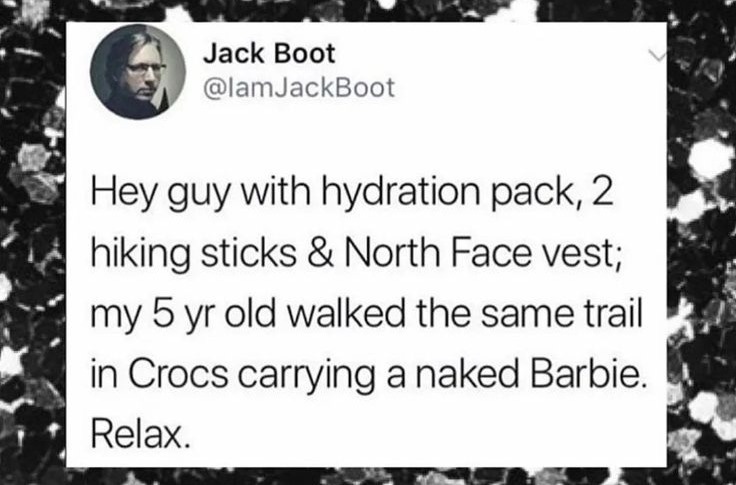
I know this meme exists, but THIS IS NOT THE VIBE, and whoever says that is a jerk. Being under-prepared is not a flex. Being prepared (or even over-prepared) is cool. If you feel better taking extra layers, packing poles, and wearing an InReach, PLEASE DO THAT.
Having said that, you don’t need “specialty” equipment to hike. You can hit the trail in sturdy shoes with good traction, your normal athletic wear, and any old pack. However, some attention to detail can make the difference between a happy, safe hike; and slipping, chafing, or sweating like crazy.
Shoes: You can hike in sneakers (or Crocs, or flip-flops—I’ve seen it all), but this is one area where I’d buy something specific. Consider a trail running sneaker or a light hiking boot, and try them on with the kind of socks you’ll be wearing. The most important point is that it fits your foot well, is comfortable, and feels stable on rocks, dirt, and mixed terrain.
Socks: Avoid 100% cotton, or your feet will sweat and you may get blisters. I like a wool-blend light hiking sock.
Pants/tops: If you wear gym-wear, you’ll do fine. Avoid jeans or 100% cotton here too, but as long as the weather is decent (above 50, not raining) just about anything else goes. You do want layers (like a light windbreaker, a base layer, a long-sleeved sun hoodie, and/or a rain jacket) in case it’s colder by the lake, you need sun or bug protection, or the weather shifts.
Pack: I like a small backpack (15L) for a day hike, to make sure I can carry extras like a small towel, a book, and binoculars. You also might be able to take a running belt or trail vest for shorter excursions. Make sure whatever you bring is comfortable and can hold everything you need, especially water.
Safety: In my pack, I keep a bandana, a Kula Cloth, Band-Aids, eye drops, extra contacts, matches, a small multi-tool, a small bottle of bug spray, a travel-sized sunscreen, and my Garmin INREACH. I wear contacts, so lens care is a priority. You may want your inhaler, ibuprofen, an ACE bandage, reading glasses, or other safety items specific to your context.
Bandanas are the ultimate hiking accessory. They can be used for sun or bug protection, in dusty conditions, for cooling (soak in a stream or lake), to mop up sweat, to provide first aid, or to offer padding against a chafing waistband or backpack strap.
3. Add water, electrolytes, and snacks

Finally, every hiker needs plenty of water, plenty of snacks, and maybe some electrolytes. I’ll always encourage you to over-prepare here. Running out of water, electrolytes, or food can turn a fun hike into a miserable one—and can put you in a truly dangerous situation.
Water: If I plan on being out for longer than an hour, I’ll take 3 liters of water. I never hike with less than 2 liters of water. Anywhere. Ever. Ideally, you’d have a water reservoir (sometimes called a “hydration bladder”) with a tube to make drinking easy and hands-free. You could also pack a big water bottle or two, though it may not be as comfortable. I always leave extra water in the car just in case.
Electrolytes: If you’re doing something active, sweating, and drinking water, you cannot forget to replenish your electrolytes. I recommend using LMNT Electrolyte drink mix (the stick packs) for hiking, especially in heat and/or at higher elevation. LMNT replenishes precious sodium lost when you sweat, and can improve your energy and keep you muscle-cramp free on the trail. Everyone I’ve given LMNT to before a hike has said, “Wow, that made a huge difference!” Add a packet or two to your water bottle, depending on how much water you’re taking, and your hike. (If I take a 3 liter reservoir, I’ll add two packets.)
Prepare your water + LMNT drink mix the night before and pop it in the fridge overnight. There is nothing as refreshing as icy cold LMNT-infused water on the trail!
Snacks: This is the most variable factor. It depends on when you’re hiking, how long the hike is, and how long it takes you to drive back home. Throw some protein, carbs, and fat in your pack, and extras in a cooler in your car. I always hike with at least 3-4 meat sticks, some pistachios or other nuts, a bag of dried mango, and 1-2 RXBARs, Larabars, or Bobo’s bars. This stuff is small so you can load up with little downside, and it’s always nice to have extra to share with a friend or stranger in trouble.
On longer or hot hikes, avoid anything that needs to be refrigerated (like a mayo-based chicken salad), or anything that’s easy to squish in a pack. (I love a good PB&J on the trail, but I’ll pack it in Tupperware.) Also, don’t eat or drink anything new on the trail. Now is not the time to have a GI disturbance! If you want to add something to your hiking snack pack, experiment at home first.
It may feel like overkill to pack water and snacks for a 1-mile loop around your local park, but packing your bag and carrying it will prepare your body for longer hikes and heavier packs. (And again—you never know.)
Happy trails!
I hope these tips give you the confidence you need to hit the trails this spring and summer! If there’s a hiking question I haven’t addressed here, leave a comment.
XO, MU

This is a great resource! Thank you for sharing!❤️